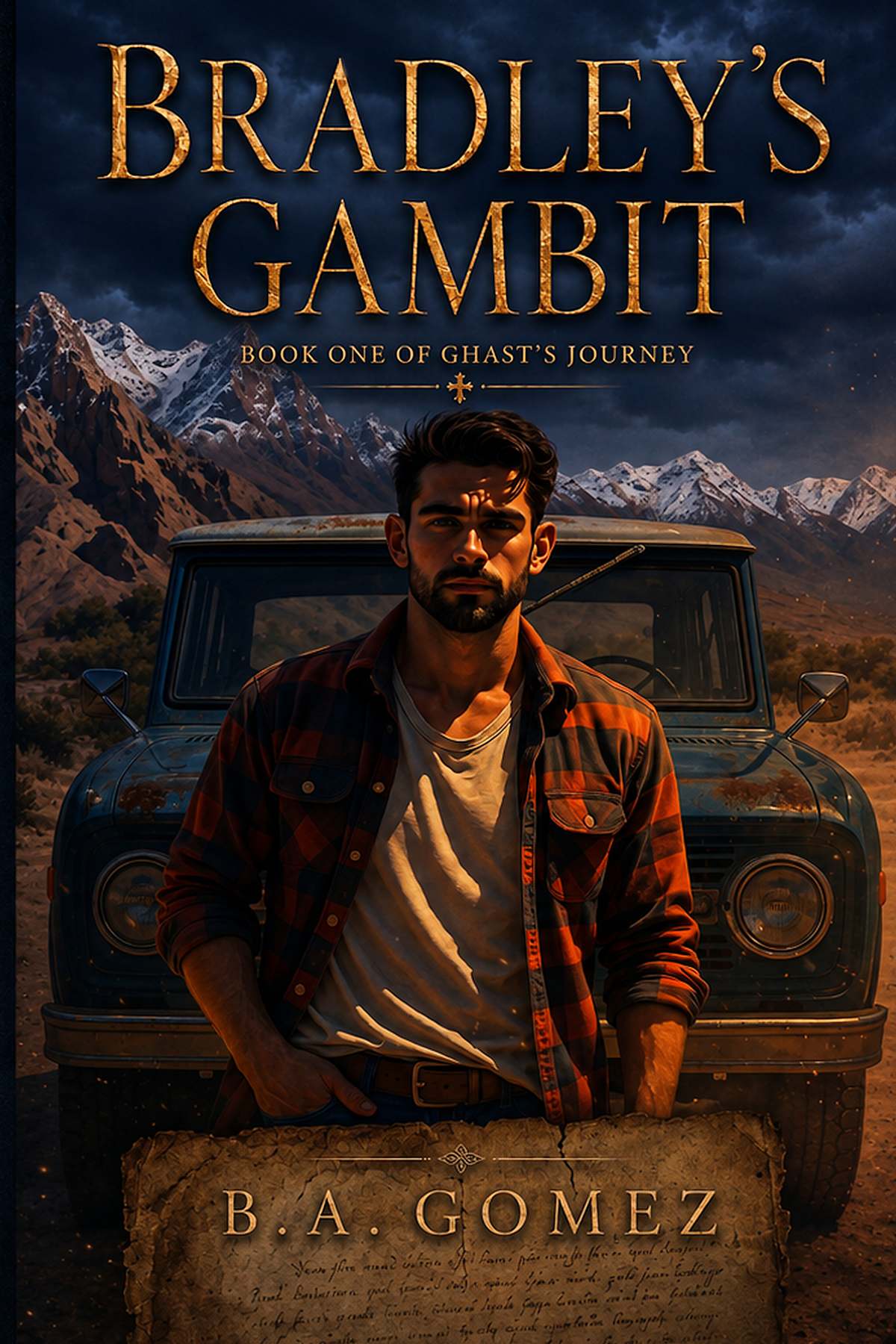
One of the things I’ve always found interesting about Bradley Ghast is that, despite everything he is capable of doing, the thing he struggles with most might be the simplest: living a normal life.
At the beginning of Bradley’s Gambit, Bradley has effectively removed himself from the world. He lives alone in an Airstream on a wooded ridge outside Montrose, Colorado. He keeps his distance from people, drinks more than he probably should, maintains his equipment, watches the terrain around him, and tells himself that quiet is enough.
On paper, he has what he wanted. Isolation. No mission. No one depending on him. Peace.
The problem is that Bradley has absolutely no idea what to do with it.
He spent years learning to notice things: movement that doesn’t belong, changes in terrain, the sound of an unfamiliar engine, the difference between coincidence and a developing pattern. Those instincts were once useful because people depended on them. Then that part of his life ended.
The instincts didn’t.
That became one of the ideas underneath Bradley’s Gambit that interested me most. What happens when someone trained to function exceptionally well in dangerous circumstances suddenly has nothing dangerous to do?
For Bradley, the answer is not immediate relaxation.
His property outside Montrose gives him distance from everything he thinks he wants to leave behind. Then trucks begin appearing where trucks shouldn’t be. Tracks show up near his land. People begin moving through the woods. A spent shell casing appears near the creek.
And Bradley does something very Bradley: he tells himself he isn’t investigating anything while very obviously investigating everything.
He takes notes. Studies tire tracks. Remembers sounds. Starts connecting events in town with activity near his property. Before long, the notebook he once used for maintenance and weather observations contains sketches, times, distances, vehicle descriptions, and patterns.
The man desperately trying not to have a mission has accidentally given himself one.
Then Teagan Anders complicates things further.
When Bradley meets her, she has already experienced something she cannot simply forget. He recognizes it, not because their experiences are identical, but because Bradley understands what it looks like when someone is carrying something they haven’t figured out how to put down yet.
That connection matters because Bradley doesn’t suddenly transform into some heroic protector after meeting her. He resists it. Repeatedly.
He tells himself none of this is his responsibility, then checks on her anyway. He notices when she is frightened. He remembers which vehicles make her nervous. He quietly begins factoring her safety into decisions he insists have nothing to do with her.
Bradley is very talented at lying to himself.
Fortunately, nobody else is particularly fooled.
The more I wrote him, the more I realized Bradley doesn’t actually miss danger. He misses purpose. There is a difference.
He spent a significant portion of his life knowing exactly why he was getting out of bed every morning. Somebody needed him. Something needed doing. Then suddenly nobody did.
Living alone on the ridge gives him safety, but it doesn’t give him purpose.
The mystery developing around Montrose does. So does Shields. Eventually, so does Teagan.
The strange irony is that the things pulling Bradley back toward danger are also pulling him back toward people.
That became the real beginning of his journey.
There are criminals in Bradley’s Gambit. There are investigations, danger, corruption, and plenty of opportunities for Bradley to demonstrate that leaving certain skills in the past is easier said than done. But I’ve never really thought the central conflict was Bradley versus whoever happened to be on the other side.
It was Bradley versus the idea that surviving was enough.
He had figured out how to exist. He had not figured out how to live.
That distinction follows him throughout the series. Bradley’s Gambit asks whether he can reconnect with the world. Bradley’s Reckoning asks what happens when the life he has started rebuilding collides with the past he thought he escaped. By Bradley’s Legacy, the question has become much larger: what does Bradley do when he finally has something worth protecting?
That entire journey begins with a man sitting alone in the Colorado mountains, insisting that all he wants is to be left alone.
Fortunately for the rest of the story, the universe does not honor his request.
— B.A. Gomez